Friday, March 13, 2015

The Composer and his Physician: Exploring the Genesis of the Rachmaninoff Second Piano Concerto

Vincent de Luise, M.D.

Piano Concerto No. 2 in c minor, Op. 18 
Sergei Rachmaninoff 

The concerto is scored for solo piano, strings, pairs of flutes, oboes, clarinets, bassoons and  and trumpets, three trombones, four horns, tuba, tympani, bass drum and cymbals


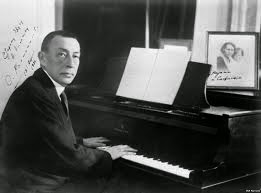
Sergei Rachmaninoff ( 1873 -1943 )

There are piano concertos and then there are piano concertos. The favorites are the Tchaikovsky first, the Beethoven fifth ("Emperor"), the Brahms first, the Chopin first, and perhaps the most beloved of all: the Rachmaninoff second, with all its lush romanticism and those unforgettable melodies. Lest one thinks that the creative process of musical composition is always something seamless, linear and positive, this essay counters that myth with the backstory of the Rachmaninoff second piano concerto, its fits and starts, its gestation, its birth and its flowering.

Sergei Vasiliev Rachmaninoff  (1 April 1873 – 28 March 1943) was born in the ancient city of Veliky Novgorod, the child of an aristocratic but impecunious Russian and Moldovan musical family. While Rachmaninoff's earliest compositional efforts cleaely display the influence of Tchaikovsky and Rimsky-Korsakov, he soon found his own Muse, “writing music with a song-like melodicism, expressiveness, full of rich orchestral colors," as Geoffrey Norris has written. "The piano is featured prominently in Rachmaninoff's compositional output, and through his own remarkable skills as a performer, he fully explored the expressive possibilities of the instrument.” 

To this day, the legacy of Rachmaninoff’s piano works, especially the concerti, has been far greater than his symphonies. The premiere of Rachmaninoff’s first symphony in 1897 actually brought the self-doubting 24-year old composer nothing but negative reception and heartache, so much so that he became severely depressed for three years. Ironically, one of his harshest critics was his older friend, and a member of the “Russian Five”, the composer César Cui, who compared Rachmaninoff’s first symphony to “the ten plagues of Egypt,” and suggested that he had studied in a “conservatory in hell.” 

That was not exactly an encouraging assessment, and the scathing comment could easily have been the end of Rachmaninoff’s career. The composer went into a deep self-doubting depression and nothing could pull him out of it, until, by chance, a friend recommended that he see him a music-loving physician, Dr. Nikolai Dahl, who restored both self-confidence and a creative spark in the composer.

Dahl was a  prominent Moscow neurologist (and a superb amateur violist) who had studied in Paris with the great Professor Jean- Martin Charcot. Charcot had begun investigating hypnotherapy as a therapeutic modality in the management of dystonia. At the turn of the last century, hypnosis was becoming accepted as a therapeutic tool. Freud used hypnosis to produce a  catharsis in his patients from their childhood traumas; Dahl’s approach was to use it as  a form of positive talk therapy. 

Beginning in January, 1900, in daily sessions over four months, Dahl worked with Rachmaninoff, using hypnotherapy, to break him of his depression. “You will begin to write your next concerto,” Dahl urged Rachmaninoff, who later recalled his many sessions with Dahl. “I heard the same hypnotic formula repeated day after day, while I lay half asleep in the armchair in Dahl’s study. Dahl would say to me, “You WILL write a Concerto. . . . You WILL work with great facility. . . . It WILL be excellent.” . . . Although it may sound incredible, this cure really helped me. By autumn, I had finished two movements of the Concerto..."

Rachmaninoff completed not only his wondrous second piano concerto, but two more besides, and dozens of other magnificent compositions in the ensuing four decades of his life. Rachmaninoff gratefully dedicated the second piano concerto  to his treating physician,  “Monsieur N. Dahl" (see image below).

The concerto  premiered on November 9, 1901 with the composer himself as soloist, has become one of most popular classical music pieces ever written, replete with a cornucopia of sublime melodies. In the concerto, Rachmaninoff channeled the lush melodic legacy of his great 19th century Romantic forebears: Liszt, Brahms and Tchaikovsky.

 Frontispiece of the second piano concerto of Sergei Rachmaninoff,
with the dedication, “a’ Monsieur N. Dahl” (courtesy uh.edu)

As James Keller insightfully explains in program notes for the San Francisco Symphony: “The first movement rises out of mysterious depths, but quickly lets loose the first of many striking themes, It is surely a virtuoso concerto, yet Rachmaninoff disguised the virtuoso element, as most of the melodies in this movement are entrusted to the orchestra rather than to the solo piano. The second movement, in contrast, is a tender meditation between piano and orchestra, with both partners offering melodic ideas, and with Rachmaninoff looking backwards to the 19th century, drawing its main theme from one of his 1890 piano compositions.” The third movement’s first melody channels music from an earlier time as well. Keller relates that “the principal theme of the finale comes from a sacred choral work that Rachmaninoff had written in 1893, but it is the second theme of this movement that has captured the hearts of music-lovers. When one is looking for a musical expression of sincere, heartfelt passion, the search leads naturally to Rachmaninoff. Even as audiences have grown increasingly baffled by modern music, Rachmaninoff’s compositions have always been reassuring, comforting and meaningful.” Since its premiere, the Concerto has been a staple in the repertoire and often used in television and film scores. 

There has been much speculation that Rachmaninoff, six-foot three and with long slender fingers that could span a twelfth on the piano, may have had either Marfan syndrome or acromegaly, neither of which condition has been proven (no autopsy was performed). What is known is that he possessed an eidetic memory for music, and was able to recall whole symphonic movements, even decades later.

Rachmaninoff continually acknowledged an inspirational debt to prior masters, writing that, "if you are a composer, you have an affinity with other composers. You can make contact with their imaginations, knowing something of their problems and their ideals. You can give their works color. That is the most important thing for me in my interpretations. You need color to make music come alive. Without color, music is dead." 

Rachmaninoff died of metastatic melanoma on March 28, 1943 in Hollywood, California, a few days before his seventieth birthday, His own ineffable Vespers (All-Night Vigil) was sung at his funeral. He was buried at Kensico Cemetery in Valhalla NY, fittingly, next to many other notable artists in the world of music.

Tuesday, March 3, 2015

WHAT AMADEUS GOT RIGHT

Vincent P. de Luise MD


"Amadeus" opened the door to a fantastic world of whose existence I had not been aware. The movie changed my life. "      (anonymous viewer of the film)

Amadeus remains one of the most beloved and decorated movies of all time. It  is a beautifully crafted film that provides us a kaleidoscopic glimpse of a grand society in a time gone by, a place of  aristocratic privilege, excess and insouciance, with artists whose works were not always recognized during their lifetimes, focusing on two composers, Wolfgang "Amadeus" Mozart and Antonio Salieri. The movie is a wondrous meditation, through the reminiscences of Salieri, on  the ways of genius, the value of contrition, and the arbitrariness of metaphysical justice.


Millions around the world have enjoyed Amadeus that was the 1984 movie, and hundreds of thousands have also experienced the compelling eponymous play that opened in London's West End in 1979 and then moved to Broadway. Amadeus has been both applauded as one of the greatest films of the twentieth century as well as criticized by some nitpicking types who can find only the historical "inaccuracies" within it. There are some who even bristle at the title, Amadeus, since Mozart himself,  in his copious writings and compositions, never used it as his middle name (N.B. : Mozart's often wrote his middle name  as "Amade' " or "Amadeo", but never as "Amadeus." Mozart's baptismal name was Johannes Chrysostomus Wolfgangus Theophilus Mozart. The name Theophilus transliterates as Gottlieb in German and Amadeus in Latin).

But that's the whole point, and the point of this essay. Amadeus was a West End play, then  a Broadway play, and then a Hollywood movie. It was not a documentary ! Those nitpickers are totally off the mark. There is a lot that Amadeus gets right ! 

Writer Peter Shaffer and Director Milos Forman  never intended to be perfectly historically accurate when they created Amadeus. Rather, in both the play and the movie, they crafted a fantasy world, loosely based on facts and channeling Pushkin's 1830 play, Mozart und Salieri, in which they opined about the relationship between genius and talent, and the gulf between ineffable art and journeyman mediocrity. They stated from the outset that Amadeus would not be historically true, but rather, a dramatic fantasy, and in so doing, they crafted a work of art which has captivated us for over three decades.

In reality, Mozart and Salieri were cordial competitors in the musical scene of late eighteenth century Vienna. They collaborated on the pastiche, Der Stein der Wiesen (The Philosopher's Stone), Salieri attended several performances of Mozart's opera, Die Zauberflote ("The Magic Flute") and loved it. Salieri even gave piano lessons to Mozart's second son in the early 1800s. There is no evidence whatsoever that Salieri had anything to do with Mozart's last illness and death; Mozart died of the consequences of rheumatic fever and hypovolemic shock from the blood-letting ordered by his physicians.

Shaffer and Forman proved throughout both play and movie that they knew a tremendous amount about the historical Mozart, more than many who want to point out those moments where the movie and play deviated from reality and historicity.

Tom Hulce, as Wolfgang Mozart, in the movie Amadeus

I would venture a guess that through Amadeus, more than a few viewers got their first deep introduction to classical music, Mozart's music in particular, as well as the beauty of 18th century Vienna (with the lovely and well-preserved Staré Město (Old Town) section of Praha (Prague), Czech Republic as its historical proxy) The sets and costumes were praised for their fidelity to what is known of Viennese culture of that era. These offerings alone are to be cherished, let alone the music (see below).

Even when the movie deviates from "the truth" about Mozart, Forman and Shaffer's deep understanding and scholarship about Mozart's creative process delights us even as it enlightens us.

For example, recall the famous scene where Salieri, as a musical amanuensis, is taking dictation from the dying Mozart as he creates the Confutatis movement of the Requiem. This event never took place in history. (It was actually Franz Xaver Sussmayr who took those notes and finished the Requiem). 

Even though the scene never happened,  through the magic of cinema, Shaffer and Forman brilliantly conjure and reconstruct the creative process of composition. The results are closer to "the truth" than anything I have seen. Here is that scene:

Tom Hulce, as Mozart, in the Confutatis scene in the 1984 film, Amadeus.
Although it was really F.X.  Sussmayr (and not Salieri) who "took notes",
this scene brilliantly deconstructs Mozart's creative process in particella writing


Some critics have commented on how "silly" and foolish" Mozart is made to appear in the movie, in the cackling laugh and puerile hijinks of Tom Hulce's characterization of the composer, while others don't accept that Mozart could have acted this way.
In fact, he did. Sexual and biological references were part of Mozart's dinner conversations with family in Salzburg and throughout his life. Scatalogical speech and coprolalia were a commonplace in the central European towns of the 18th century. Hulce's brilliant characterization of Mozart was actually sanitized from reality. Shaffer and Forman were spot-in caricaturization as well. Mozart's own letters to his parents, sister, and especially to his cousin, Anna Maria Thekla Mozart (nicknamed the Basle) when they were both teenagers, are replete with bathroom humor and sexual innuendo. 

Shaffer and Forman took the viewer much farther, by letting them enter Mozart's sublime and serene sound world. The movie is replete with dozens of Mozart's  musical masterpieces, splendidly performed by Sir Neville Marriner and the Academy-of-St-Martin-in-the Fields. This sonic Mozartean glory alone is priceless and uplifting.

Beyond honoring Mozart and his brilliant musical legacy, Shaffer and Forman actually did more to resuscitate and revive Salieri than anyone else in the music world had done to that point, by showcasing the finale of his greatest opera, Axur, Re di Ormo (Axur, King of Ormus), complete with over-the-top period costumes and set design. The scene is unforgettable.

Shaffer and Forman won eight well-deserved Academy Awards for Amadeus and have been lauded for having created a wondrous jewel that honors Mozart by having introduced his ineffable music to millions.

So, thank you, Peter Shaffer, Milos Forman, and Saul Saenz, for opening the eyes and ears of the world to Mozart. Thank you, actors Tom Hulce (Mozart), F. Murray Abraham (Sallieri), Elizabeth Berridge (Constanze), Jeffrey Jones (Emperor Joseph II) and your colleagues, for informing your characters with such depth and authenticity. You got Amadeus so right !

Ars longa !
Ars Mozartiae longior !

@ Vincent P. de Luise MD 2015

Saturday, September 20, 2014

High Touch: The Course in Compassion

Rebuilding a Curriculum of Caring for Healthcare

Embedding a foundational  "toolkit" of  compassion in present and future physicians  is essential for  improved patient-physician engagement and communication, for physician professional satisfaction, and to prevent physician burn-out. This essay was written as a project paper for the Harvard University Advanced Leadership Initiative in which I was a 2013 Fellow.

 
          "May I see in all who suffer only the fellow human being" 
                                                                           Maimonides                                                 
The Problem

Healthcare is broken and doctors are burning out.

That is the current mantra. Healthcare has gotten too expensive and impersonal, and there is inconsistent access to that care. Doctors are increasingly stressed and do not seem as engaged. Patients complain that their doctors are too busy and no longer listen. They ask, “Who will take care of me as a person and not just as a bunch of x-rays and lab test results?” I trust my doctor, but why does she seem so distracted and disengaged.” With all the technological advances of the last several decades, with genomics and PET scans, MRIs and super-subspecialists for every conceivable body part, what in the world is happening to the very doctors who care for us?  We have all this “High Tech,” but, where is the “High Touch?”  Is being a physician no longer a calling?  Has it become just another job?  Have patients become commodities? Why has doctoring gone astray?   

Gaps

The American system of medicine has become organized largely as a disease-management system, and not as a health-care system, with diagnoses and treatments now reduced to an impersonal set of numerical codes. The concept of “caring” is no longer central to a discussion of “health care.” Patients are being viewed by their health care providers more as the sum of their diagnostic testing, or as the "I-patient," to use the term coined by Abraham Verghese M.D. of Stanford University, which is to say, the "virtual" patient, seen by the physician more through the lens of that physician’s pda, laptop or computer screen, and not as the real, live, hurting individual in front of them.

Of course, this is an oversimplification. There are legions of dedicated doctors who are serving an ever larger and aging population, and who do so with empathy.  But we as a society have indeed reached a watershed moment, a saturation point on many fronts. We now live ever more hectic and hurried lives, with hardly a moment to stop and reflect. With increasing demands on our time and resources, we have become more anxious, are getting less sleep, and are making poorer dietary choices. The cumulative effect of this leads to illness. However, when we get sick, we still want help, and we have come to expect that help to be prompt and caring. Yet, even when we do find that help, it seems to have become curiously robotic and disengaged.

It is crucial for the health care profession – now a health care system, comprised of collaborative teams of physicians, nurses, PAs, social workers, ethicists, and even economists – to remain focused, engaged, vibrant, and committed to caring. We cannot have it any other way. We cannot be a healthy society, with healthy citizens contributing to the success and happiness of that society, without an engaged health care team. We need to (re)-train physicians for a lifetime of caring, so that they continually demonstrate empathy in their work, and so that they themselves remain energized and happy in their careers, as this will improve patient outcomes over time.

Physicians cannot heal without caring, and they cannot care without first being informed by a core set of ideals that will carry through their training and into their professional careers.  Medical schools are set up to train physicians, and at many of them, there is already an awareness of these problems which I have outlined, and some initiatives are in place. But the system, engrained and with its own cultures and rituals and focused on disease management, has lost sight of its ideals, the ideals embodied in the Hippocratic Oath.
 
A Solution: Frameworks in Medical Humanities

We must re-embed a pathway of caring in our health care providers and transfer a lifelong set of skills that will inform them throughout their careers, certainly in the physicians who still lead the health care team. What is needed is an overarching and cohesive rubric, which I have entitled The Course in Compassion: A Curriculum of Caring (The Course). These skills can be identified, quantified and measured, and will populate The Course.  The Course will be divided into modules, and taught using an accepted paradigm in most medical schools, the Problem-Based Learning (PBL) format. Six core modules, which are termed “Frameworks in Medical Humanities,” would be taught over the four years of medical school in weekly two-hour sessions:


                Sensory experience                      Motor task


           Dance and Movement                  Motion Research


           Music Appreciation                      Rhythm/Melody-Making


           Narrative & Reflective writing       Diary-Keeping


           Mindfulness and Spirituality          Yoga/Meditation 


           Art & Aesthetic Appreciation        Drawing/Sketching


           Empathy Training & Acting          Care-Giving


Stakeholders

Patients, physicians and physicians-in-training (medical students and house officers), medical school administrators, curriculum designers, The Association of American Medical Colleges, state licensing boards, and insurance companies – each of these entities is a stakeholder with a say in physician education. Adopting  The Course will require hours of time to teach its principles, hours that will have to be taken in part from existing core disciplines as anatomy, biochemistry, pathology, physiology and microbiology, as well as from time already assigned to the medical students for hospital wards and outpatient clinics. Conversations will need to occur at many levels to allow stakeholders to “buy-in” to  The Course as a foundational aspect of medical education.

However, The Course does not have to be built “from scratch.”  There exist a number of programs which have pilot projects aligned with my vision and ideas. A number of medical schools, (Harvard, Yale, Weill Cornell, Johns Hopkins, Stanford, UCSF, and Columbia, inter alia), offer courses which champion aspects of The Course. These existing initiatives are already testing the “proof of principle” of The Course. They are virtually all elective (that is, they are not required to graduate), but they exist. Therefore, it is not necessary to “reinvent the wheel” to populate the syllabus of The Course. Rather, The Course would be populated with “best practices” from existing efforts in addition to new initiatives I would add that have not yet been created or tested.

As Harvard Business School Professor Rosabeth Moss Kanter has written, change is often a result of Big Vision and Small Steps.” The Big Vision is creating and curating The Course in Compassion: A Curriculum of Caring (The Course). The small, essential and crucial steps are to pilot a series of medical humanities courses in all six modules, and, utilizing longitudinal data analysis, create metrics to measure patient outcomes and satisfaction over time, and physician satisfaction through their careers.

 Impact
 
“It is far more important to know what person the disease has than what disease the person has.”  
                                                             Hippocrates                                  
 
Medical humanism is a core set of ideals that should be taught from college through medical school, internship and residency, and that should continue to inform a physician through their career. Medical humanism serves as a beacon and lodestone for how physicians listen, respond and care for their patients, as well as providing a road map for the well-being of a physician’s own mind and body over the course of their professional lives. The Course in Compassion will be a foundational paradigm around which physicians can be better engaged, and more motivated and passionate about providing care. Patients will achieve better outcomes, and physicians and their healthcare teams will enjoy longer and more fulfilling careers. This is an initiative which can no longer be fragmented, ad hoc and elective. The Course must become the epicenter of medical education and professional practice.

©   Vincent P. de Luise MD FACS

Tuesday, August 19, 2014

Undying Love, Murder, Plot, Dinner - A Magical " Magic Flute" Evening in Middlebury

Connecticut Magazine:Arts & Entertainment

Undying Love, Murder Plot, (Dinner)—A Magic (Flute) Evening in Middlebury


The role of Pamina in Die Zauberflote (The Magic Flute)
 will be sung by soprano Rebecca Palmer


Evening ascends toward its loveliest moments of the year as August slides down the back of high summer toward September. The heat of piercing days begins to abate, the light grows gentler and more diffuse, hinting of autumn, and yet a feeling remains that idylls are still allowed and pressures may be discounted.
It’s the perfect time to go out—for day trips, walks in the woods, visits to museums, and long, lingering dinners. In culture-rich Connecticut, all of that can be very satisfying, like perfect chamber music.
If you dare to turn up the volume, a terrific opportunity awaits August 23rd, in Middlebury, to experience some of the state’s unsung cultural amenities at a level that is a little more, well, operatic.
The full experience features dinner and drinks in a singular venue, a lovely walk to one of the state’s prettiest private school campuses, and then—with the dessert course served during intermission—a performance of the legendary tale (set in a mythical kingdom) of two sets of lovers seeking redemptive unions. Along the way to an ultimately happy ending there’s enslavement and a murder plot.

The event is a fully-staged (and costumed) production, with orchestra, of Mozart's “sublime and delightful last opera, "Die Zauberflote (“The Magic Flute”) K.V. 620.
                                                                                                           The opera is being presented by the Connecticut Lyric Opera Summer Institute, and the Connecticut Virtuosi Orchestra, in collaboration with the Woodbury - based Connecticut Summer Opera Foundation (CSOF), which is sponsoring and promoting the event.

This production of “The Magic Flute” is the capstone of the CLO summer program for aspiring singers, held at Tunxis Community College in Farmington. It begins at 7:30 p.m. in the theater at The Westover School (1237 Whittemore Road in Middlebury.) Tickets are $40; $20 for senior citizens and students. Tickets will be available at the door, but those planning ahead can also send checks, payable to CSOF to: CSOF, P.O. Box 112,  Woodbury CT 06798. (Tickets will be held at the door.)

Apart from the opportunity to see a fully-staged opera presented by a professional company (the last in Connecticut), what makes this event special is the larger experience being offered.
Guests are invited to begin the evening at 5:30 p.m. with a two-course  "Evening at the Opera dinner" at the nearby The Café at Whittemore Crossing, (right, the kitchen) a unique venue located in the same Shingle-style manse Middlebury Consignment and The Shoppes at Whittemore Crossing. The cost, excluding tax and alcohol, is just $29.99. (Call the café directly for reservations and menu options, at 203-528-0130 , and  see the details and register online.)

After dinner, guests will leave their cars at Whittemore Crossing and enjoy a slice of the evening by walking the short distance to Westover (which has very limited parking). And dessert comes as the course served during intermission at the opera.
Altogether it’s a richly different and stimulating evening out that’s also a bargain (especially in the world of professional opera presentations).

All of those attributes are offered thanks, in large part, to Dr. Vincent de Luise, MD, president of the Connecticut Summer Opera Foundation, founded in 2012 to to provide valuable performance experience to up-and-coming conservatory-trained singers, and to bring opera to young adults, exposing the next generation of concert-goers to the art form. (The other principal members are Carole Winer-Sorensen of The Country Loft special events venue and French antiques shop, Karen Reddington-Hughes of Abrash Galleries antique rugs and Maria Jablon.).

“Our mission and our passion is opera, and vocal music, and promoting it in Litchfield County,”
Dr. de Luise says in a phone conversation about the “The Magic Flute” production.
Having attended a Master Class event Aug. 9 at Westover that featured some of the singers performing in “The Magic Flute,” Dr. de Luise can attest to how high the quality will be. (At the Master Class “superstar soprano” Jurate Svedaite , artistic co-director of the CLO’s summer institute, and Maestro Adrian Sylveen, artistic director and conductor of CLO and conductor of the Connecticut Virtuosi Orchestra, offered “a wonderful glimpse into the creative process of making vocal music!") 
Soprano Jurate Svedaite co-drects the CLO Summer Institute
Just as students performers will be featured in “The Magic Flute,”  the orchestra that evening will consist of roughly half professional musicians and half students. “I think ‘The Magic Flute’ is a perfect summer choice,” Dr. de Luise says, "in part because it can be viewed on so many different levels, and is an opera easily enjoyed by children."
In one way, it’s “the straightforward story of a prince and a princess and their undying love and devotion to each other, in the face of the usual, various and sundry forces of darkness and operatic mortal dangers, who come through these travails unscathed,” Dr. De Luise writes in “Mozart's Magical Mystery Tour de Force: Unraveling the Threads of Die Zauberflöte,” an essay written for the program book of an Opera Company of Brooklyn's concert performance.

CLO Artistic Director Adrian Sylveen
Dr. de Luise adds, “Die Zauberflöte" can be viewed as nothing more than another delightful opera by a great composer, this particular one quite approachable by both children and adults, a charming musical fairy tale that is replete with hummable tunes, a certifiable hero and  heroine, comical characters, a story line that is easy to follow, with  exciting moments and a happy ending, in which truth, morality, personal integrity, love and fidelity  win out.”
Ah, but those thoughts are just the overture to Dr. de Luise’s much deeper essay, which goes on to plumb the depth’s of “The Magic Flute’s” “allusions that exist on a deeper and more introspective plane … ,” with none “more foundational than the Masonic symbols that serve as  leitmotifs and recurrent threads throughout the opera.”
Digging even deeper, Dr. de Luise asks, “Could Die Zauberflöte also have contained  a hidden political agenda?” (Read his essay to discover the answer.)
On whatever level you choose to enjoy “The Magic Flute,” don’t miss this rare opportunity to enjoy a magical evening amid the late-summer beauty of the Litchfield Hills, with dinner and a substantive “cultural entree”—and also, of course, with generous spicing from love, plotting, dark deeds and a quest like none other.
See the website of Facebook page of the Connecticut Summer Opera Foundation to connect with the Aug. 23 performance.
To attend dinner at The Cafe at Whittemore Crossing, call 203-528-0130 for reservations and menu options, or go online.
The CSOF is a fully-volunteer 501(c)3 nonprofit arts organization. Anyone with a passion for opera and classical music who is interested in joining the team may call Dr. de Luise directly at 203-232-9028.


Reader Comments