Monday, December 5, 2011

A Block Island Reverie: Thirty Years of Journeys, Trips and Vacations to Rhode Island's Jewel

(This essay was written for the March 2012 gallery exhibit on Block Island which I curated at the Woodbury, CT  Public Library)


"....Then is that lonely island fair;
And the pale health-seeker findeth there
The wine of life in its pleasant air...."
                                              John Greenleaf Whittier
                                           "The Palatine" (1867)

    Block Island, that tiny tear drop-shaped island jewel in the Atlantic, always beckons. Although Block Island begins and ends as a physical space, lying thirteen miles south of Point Judith, Rhode Island, and fourteen miles east of Montauk Point, New York, and deservedly  (if unwittingly) wearing the nickname "The Bermuda of the North," it is nevertheless as much  concept as  reality. Block Island is a place one longs for as well as visits, a state of mind in addition to a place for the body. 

    For over a century, Block Island has been a popular summer vacation spot and  destination for tourists and travelers, weekenders and daytrippers, revelers and romantics, a place that is close enough from much of southern New England to get to in a morning's travel, but far enough away that one knows that they have journeyed to somewhere else. The reason why Block Island is such a beautiful island retreat is that it is at once a natural treasure, containing a unique and fragile ecosystem. These seeming contradictions are Block Island's most sublime quality, that it can simultaneously display these disparate pleasures.


Crescent Beach, looking North
to beautiful and secluded
Mansion Beach
There is a deep and enduring beauty about Block Island, a lyrical beauty that has often been written about and photographed, but never completely captured or encapsulated. Block Island is not the ostentatious and easy beauty of Miami Beach, though her Crescent Beach vies with the East Coast’s best. Block Island is not the visceral beauty of the Grand Canyon, though looking down from Mohegan Bluffs to the pounding surf of the Atlantic Ocean can grip the imagination just as forcefully. Block Island is not the awesome beauty of Niagara Falls, though navigating the cut above North Light can be equally exhilarating and treacherous. Block Island is not the majestic beauty of the Rockies, though climbing to the top of Pilot Hill and seeing the coastal contours of three states at once is just as remarkable. Block Island is its own special place.

    For almost thirty years, our family has sojourned on Block Island. Our children have grown up frolicking on its sandy beaches, caressed by those soft, omnipresent zephyr winds, hiking its Clayhead trails, holding its tidal periwinkles and starfish in their hands and marking each summer season with a trip to "the Block," all the while internalizing and revering the Island's unique and tenuous beauty; and their future children will in turn someday inherit their own pride of place in this wondrous space.

    Geologically, Block Island is but an after-thought, an appendix to Earth’s grand and ancient story, a speck of land at the mouth of Long Island Sound that represents a small fragment of recessional moraine that was left by the receding glaciers of the last Ice Age. That event took place around 20,000 years ago, during what is known as the Laurentide glacier retreat of the Wisconsonian glaciation. The land masses destined to be Block Island, Martha’s Vineyard, the Cuttyhunk Islands, Nantucket and the eastern forks of Long Island all formed then, from similar erosive forces of nature, fully separating from the mainland of New England over 8,000 years ago. Of these islands, Block Island alone lay claims to one of nature's great gifts – that certain animals and plants survive, even thrive, within her shores, and almost nowhere else on Earth.

Block Island Meadow Vole
Microtus pennsylvanicus provectus
     Block Island is arguably the most significant biological niche in the Northeast, whose unique ecology supports a remarkable variety of wildlife, including over forty species classified as either rare or endangered. Thousands of migratory shorebirds, waterfowl, raptors, and song-birds sojourn on Block Island as a stopover point on their journey north and south along the Atlantic Flyway. Acres of rare grasses and iconic beach roses (Rosa rugosa) grow and flourish among the protected dunes around the Island
Beach Rose
Rosa rugosa
     It has been said that there are as many natural ponds on Block Island as there are days in the year. Indeed, over three hundred fifty ponds dot the Island, almost all of them so-called "kettle pots" or "kettle ponds," a result of glacial scouring, hollowing and melt, which provide a home and refuge for green frogs and peepers, red-spotted newts and spotted turtles, eastern painted turtles and diamondback terrapins. According to the US Fish and Wildlife Service, "there is speculation that some of these may be distinct subspecies, since they have been separated from mainland populations for at least 8,000 years." One wonders whether these fauna were indigenous, or brought over from the mainland either by the Naragansetts or subsequent settlers. Notwithstanding the specific source of their origin on the Island, the fact that such a diversity of animal and plant life thrives on such a tiny piece of land as Block Island is testimony to its uniqueness and importance.
Great Salt Pond, an aerial view
The breach into the Atlantic can be
seen in the top left of the photograph

  The largest freshwater pond on Block Island is Fresh Pond, which has been a source of potable water since the time of the Naragansetts, the native Americans who had colonized it over two millennia ago.

  Great Salt Pond, as evidenced by its name, is no longer a true freshwater pond, because it has been breached into the Atlantic. The breach of Great Salt Pond happened episodically over centuries during fierce storms, and then purposefully, when after numerous attempts, a cut was finally properly and permanently dredged in the northwest corner of the Pond in 1895.  This allowed commercial ships and, these days, pleasure craft of all styles and sizes, to be harbored in its commodious and protected waters.

Piping Plover
Charadrius melodus

    Since the 1960s, all of Block Island's biota and almost half of its open space have become permanently protected. This us a result of enlightened stewardship and the tireless political efforts of many concerned and philanthropic Islanders, as well as by several far-reaching and visionary statutes from Providence (the capital of the state of Rhode Island, not a kingdom of heaven, though both may be correct in this case).
Regal Fritillary Butterfly
        Speyeria idalia Drury
      Endangered world-wide
     Block Island's delicate ecosystem has been designated as one of thirteen "Last Great Places" by The Nature Conservancy, which has identified "Block Island as more than just home to rare and endangered plants and animals. It also supports a vibrant, active human community with a strong sense of its cultural and natural heritage. The overwhelming local commitment to conservation inspired The Nature Conservancy to name Block Island one of thirteen “Last Great Places” in the Western Hemisphere. With the hard work of many individuals and an assembly of conservation organizations, almost half of the Island is now protected; protected for plants, animals, and people in perpetuity.
North American burying beetle
Nicrophorus americanus

  Among the rare and endangered animal species found on Block Island are the North American burying beetle (Nicrophorus americanus), the Regal fritillary butterfly (Speyeria idalia Drury), the Block Island meadow vole (Microtus pennsylvanicus provectus), and the piping plover (Charadrius melodus). These are examples of unique species which live virtually nowhere else on Earth. Recent genetic evidence supports the thesis that some of these animals actually represent separate species, given that Block Island has been separated from the mainland for over 8,000 years, enough time to allow for speciation to occur.

     Archaeological findings document that Block Island has been inhabited for over two milennia. The Narragansett Indians, a branch of the Algonquin, were the native Americans who populated the Island prior to the first English settlers, calling it Manisses, which means "Island of the little Manitou" (Manitou is Algonquin for "life-force" or "spirit"). The Narragansetts made their settlement near the southern shore of Great Salt Pond. The numerous quahog shell middens excavated there underscore that it was a rich and fertile area, a veritable "Garden of Eden of natural resources" according to an archaeologist who has studied the area.

   In 1524, the Italian explorer Giovanni da Verrazzano, sailing in the employ of the French Court, sighted the Island and named it Claudia, in honor of Claude, Duchess of Brittany, queen consort of France and the spouse of Francis I. However, several contemporaneous maps of the era identify the same island as Luisa, after Louise of Savoy, the Queen Mother of France and the mother of Francis I. Verrazano never landed, but described Claudia (Luisa) as he sailed past as being  " full of hills, covered with trees, well peopled for we saw fires along the coast...."

The Blaeu Map of 1635
showing "Adrien Blocs Eylandt"
("Adriaen Block's Island")
     In 1614, Block Island was charted by the Dutch explorer Adriaen Block, who began to trade with the Narragansetts, and then named it for himself. (It remains a mystery if Captain Block ever saw any maps with Claudia or Luisa on them). However, finely detailed Dutch maps of the early seventeenth century do show a "Block Island" (see above), indicated as "Adriaen Blocs Eylandt" ("Adrian Block's Island"). Block also named one of the islands in Narragansett Bay as "Rood ("Red") Island." The name "Rood" or "Rhode" stuck as the name of the future state, Rhode Island. That same Adriaen Block is also remembered today as the first European settler to build a house on another island,  that of Manhattan, near what is now Wall Street.

    It does not appear that Block or his crew actually landed on Block Island. That distinction was earned adversarially, as an expedition of twenty men from Boston and environs arrived on Block Island sometime in the spring of 1636, to retaliate against the Narragansetts for killing a certain John Oldham, and the Island was thus made a part of the Massachusetts Bay Colony.

An early map of New England

showing Block Island
 (Homann, Nuremburg, 1716)
    Later, in 1661, a group of sixteen settlers from the Providence area sailed over from Rhode Island, and purchased the island. As these settlers' philosophy and mores were more consonant with those of their peers in Rhode Island, Block Island subsequently became part of the colony of Rhode Island and Providence Plantations in 1672. Soon thereafter, the Island government adopted the name New Shoreham for both the Island itself and for its only town, the lovely, Victorian-styled port area framed by Old Harbor and its charming streets, evocatively called Water, High, Spring, Dodge, Weldon's and Chapel.

   Block Island's maritime geography can be likened at times to the sirens of Greek mythology, at once beautiful but also treacherous. Over the centuries, there have been numerous shipwrecks off her shores, in particular on a submerged spit of land that carries forth from the northernmost part of the island called Sandy Point (termed the "Hummock" in earlier times), and an equally dangerous area around the southeast coast, just off-shore from the Mohegan Bluffs.

    It was near that northernmost spot that the so-called "spirit-fire ship" Princess Augustus (also known as "The Palatine") got marooned in 1738, spawning John Greenleaf Whittier's elegiac but somewhat deprecating poem about the Island and its inhabitants, "The Wreck of the Palatine" (1867), which engages the reader from among its first lines:

"....Circled by waters that never freeze
Beaten by billow and swept by breeze
Lieth the island of Manisses...

When the hills are sweet with the brier-rose,
And, hid in the warm, soft dells, unclose
Flowers the mainland rarely knows....

No greener valleys the sun invite,
On smoother beaches no sea-birds light,
No blue waves shatter to foam more white..."

Southeast Light, which in 1993 was
moved about 250 feet from the bluffs,
emblematic of BI's conservancy
  Today, two majestic and powerful lighthouses, the granite-hewn North Light (1867) and the red-brick Southeast Light (1873), identify those two insidious areas on the Island's coast, alerting modern-day sea captains of submerged perils. Both lighthouses have been lovingly maintained over the years. In 1993, the Southeast Light, a National Historic Landmark, was lifted and moved two hundred fifty feet back from the cliffs of the Mohegan Bluffs, sparing it from otherwise collapsing down into the Atlantic for at least one hundred years. The bulk of the two million dollar project was raised by private donations from islanders, vacationers and committed citizens, whose collective effort is in the great spirit of Block Island philanthropy and conservancy.

The granite-hewn North Light (1867)

    Just as Nantucket, Martha's Vineyard and the other so-called "Outer Lands"  (Cape Cod, Long Island and the islands)  in the North Atlantic have their own interesting stories and memorable individuals, so too does Block Island have its share of fascinating tales and colorful characters. One of the most remarkable was Edward Searles (1841-1920), interior designer, architect, dreamer, visionary, eccentric multimillionaire and builder of one of Block Island's most singular edifices.
   
   Edward Francis Searles was born in Methuen, Massachusetts, and apprenticed with the renowned design firm Herter Brothers in NYC in the 1870s. He soon found himself advising on the decoration of the mansions of the rich and the famous, and apparently of the widowed as well.

    It so happened that in 1881 Searles was sent out to San Francisco by Herter Brothers to assist a certain Mrs. Mary Francis (nee Sherwood) Hopkins in the decoration of her new home. Mrs Mary Sherwood Hopkins just happened to be THE Mrs. Mark Hopkins, the widow of Mark Hopkins, the San Francisco railroad magnate. Mrs. Hopkins was finishing her mansion atop Nob Hill  (the site of the current Mark Hopkins Hotel; her mansion was destroyed in the three day fire after the 1906 earthwuake) and found a kindred spirit in design and the arts in Mr. Searles.

     Evidently Mrs. Hopkins was pleased with Mr. Searles' work in San Francisco because she helped Searles secure a second commission in 1885, this time for the interior design of another of her  baronial mansions, a jewel of an edifice in her birthplace of Great Barrington, Massachusetts. The stone mansion, which came to be known as Kellogg Terrace (and is now reincarnated as the Dewey Academy for Boys), was, then as it is now, a masterpiece of gothic and neo-renaissance architecture. 

The close and constant companionship between Mr. Searles and Mrs. Hopkins in the Kellogg Terrace project led to a more intimate friendship, and then, perhaps inevitable given their kindred spirits, a May-September romance, as the sixty-eight year old Mrs Hopkins was twenty-two years Searles' elder (and one of the earlier cougars on record). On November 7, 1887, the perpetual bachelor Mr. Searles married the wealthy widow of the railroad magnate, Mrs. Hopkins. 

   Searles then really went to work, adding a host of truly baroque additions to Kellogg Terrace, including a giant nave on its west side which was planned as the music hall, outfitting it with one of the largest pipe organs ever built in a private residence in the United States. 

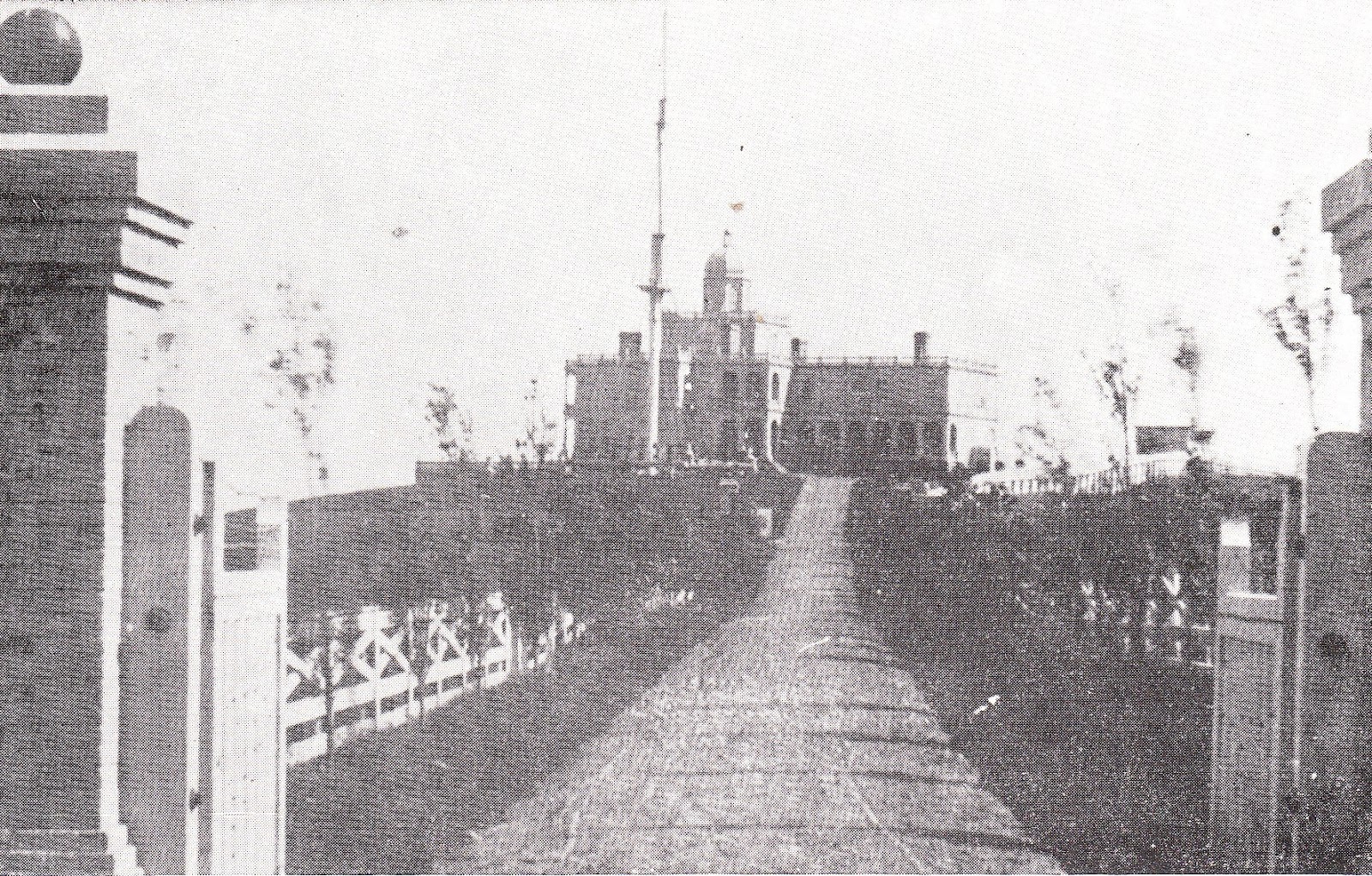
    While Searles was finishing the interiors of the Great Barrington mansion, he bought several large parcels of land on Block Island's Corn Neck, originally amounting to almost sixty-five acres, extending from the Great Salt Pond to the Atlantic. It was there, at the north end of Crescent Beach, that  he built his "Dream House" as he called it, the opulent mansion then known as "White Hall."  

   Mr and Mrs Searles must have developed very different and individual tastes because, as the photo below shows, Mr. Searles had his architect, the brilliant Englishman Henry Vaughn (who brought over English Gothic style and popularized the Gothic Revival style of architecture), design the mansion with two gigantic, identical, and bilaterally symmetrical "His and Hers" wings, separated from each other by a massive two-story central hall complete with a grand staircase! 

The wood and stone structure was so big and of such a bright white color from its rusticated wood that it could be seen by ships from miles away, actually appearing as a point of interest on nautical maps of the time ("white ho' flat-top" - the "flat top" monicker because Searles had the cupola (see below)  removed along the way). White Hall soon became known locally by Block Islanders as the "Mansion House," and that part of Crescent Beach was thus re-christened "Mansion Beach."

White Hall in 1888
The so-called "Mansion House" or Searles Mansion
right after its completion. Note the cupola on top.

    After Mrs. Hopkins-Searles' death in 1891, Mr. Searles largely abandoned the Mansion House. However, his inheritance of 21 million dollars (the equivalent of approximately 400 million in today's dollars!) and vast real estate holdings, allowed him an even freer reign to design and build several other similarly extraordinary properties, to wit, the two fantastic castles he conjured and then actualized with Henry Vaughn: Pine Lodge, in Methuen, Massachusetts, in 1910, and Stanton Harcourt Castle, a few miles up the road,  in Windham, New Hampshire, in 1915, where he found the property and estate taxes to be less onerous.

    Searles himself passed away in 1920, and his Block Island Mansion House lay largely abandoned, becoming the episodic location of unofficial drinking parties and dances during and after prohibition. The town of New Shoreham bought the property in 1929 and subsequently sold it several years later to a certain Oliver P. Rose. 

    It changed hands a few times after that, and in the mid-1950s, , Ernest Pollien of Westport, Connecticut, who had been buying and selling Block Island properties for several years, purchased the Mansion House and made a credible attempt at rescuing it, refinishing it and rehabilitating it  as a holiday retreat. The Mansion House continued on for a while longer, and then, one night in April 1963, it mysteriously burned to the ground. Arson was suspected, but no one has ever been implicated.

White Hall, aka The Mansion House
The cupola was removed after being hit by lightning.
The building mysteriously burned to the ground in 1963.

     Today, all that remains of the once imposing Mansion House are parts of the two brick pediments where the entrance had been, and a bit of the foundation, on which everyone who can get there early enough in the morning parks their cars or SUVs, and walks down to, where else?, Mansion Beach! 
(you can read more about the Mansion House, White Hall, at
http://amusicalvision.blogspot.com/2014/07/searles-folly-story-behind-block.html 

    Another Block Island tale concerns the privateer William Kidd, yes, Captain Kidd himself ! The story goes that Kidd and his buccaneers visited Block Island several times in the late 1690s. Kidd was said to have buried some treasure on Block Island, and given the island's isolated position at the mouth of Long island Sound, this is certainly a possibility. Over the centuries, numerous attempts to find said buried treasure have been mounted. According to Block Island historian Ethel Colt Ritchie, what used to be called the Old Road, past the Harbor School House, has been one site of these digs for "buried treasure," all of which so far have come up empty.
William Kidd
(1645-1701)
"Captain Kidd"
Did he bury gold on Block Island in 1699?
    But Kidd and his men did anchor their sloop, the San Antonio, on Block Island, sometime in 1699, in what is now the Old Harbor area, and according to several reliable accounts, they were given provisions there by a certain Mrs. Mercy Raymond (nee Sands). For her kindnesses, Kidd asked Mrs Raymond to hold out her apron, and he filled it with gold coins and jewels. After her husband passed away, Mrs Raymond moved her family to the area of Montville Connecticut, where she bought an enormous parcel of land and the family was said to have been "enriched by the apron."
A view of a Victorian Building
from Rebecca's Statue on Water Street
   Block Island is informed by all of these many fascinating and intriguing aspects, an island haven with rare and unusal fauna and beautiful flora, a quirky past history, a big red-brick lighthouse that was actually lifted up and moved, and possibly even some buried treasure waiting to be discovered. However, Block Island is unique and wondrous in so many other ways, perhaps quotidian, yet even more indelible: there are no traffic lights on the Island; bicycling and walking are the most common modes of transportation; moss-covered low stone walls still demarcate many property lines as they did over three centuries ago; there is a view of water, either of ponds or of the ocean, from virtually any spot on the Island; there are no garish chain stores or marquees to spoil its rural character (however there are three ice cream parlors to delight the palate); virtually all of the town architecture is Victorian.
The Spring House porch, as captured
by Mary Harty and Peter de Rosa in
American Vision, 1981
     The Narragansetts had it right. The "God of small things" lives and plays on Block Island, frolicking in its waters and rejoicing within its vales. Block Island remains this remarkable, pristine and special place, a psychic space really, a sanctuary somewhere over the rainbow, a rare and magical natural kingdom that actually exists, and will continue quietly co-existing, with our precious Earth.
copyright 2012 Vincent de Luise, M.D.  A Musical Vision

http://amusicalvision.blogspot.com/2014/07/searles-folly-story-behind-block.html 

Sunday, November 27, 2011

Gounod (and Shakespeare and Bernstein) in Love: Through the years with Roméo et Juliette

(This essay appeared in the program book of Opera Company of Brooklyn's concert performance of Roméo et Juliette by Charles Gounod. I am indebted to the writings and scholarship of Professor Jeffrey Langford, Assistant Dean for Doctoral Studies and Chair of the Music History Department at Manhattan School of Music. With Dr. Langford’s permission, I have included several sections of his chapter, Gounod’s Roméo et Juliette: Rewriting Shakespeare,  from his engaging book, Evenings At The Opera, Amadeus Press, NY, 2011. Professor Langford’s sections are acknowledged where they appear.   VPD)
                                                 
 
Charles Gounod in 1859,
the year of  Ave Maria
and the premier of Faust
    Is French opera, like truffles and foie gras, an acquired taste? If French opera is qualitatively  different from its Italian and German siblings, and it is, it most certainly contains its own unique and undeniable charms. Those who have been brought up and schooled in the lively and melodic world of Italian opera, with its rhythmic cadence and recitative, its easily rhyming vowel-rich language and its showy, florid and ornamented arias, the folksy but noble German Singspiel tradition, or the power and intensity of Wagnerian opera, should take the time to enjoy the nuanced and refined flavors of the French form. For French opera is indeed one of the world's great and enduring operatic traditions, beginning with the seventeenth century Baroque masterpieces of Rameau, Charpentier and Lully, which led to the highly stylized operas of Christoph Willibald von Gluck in the eighteenth century, and later, those of Luigi Cherubini. These works were followed by the establishment of the grand French operatic style by Gioacchino Rossini, whose Guillaume Tell (William Tell) singularly begat the genre, and the subsequent and splendid opéras lyrique and comique of George Bizet and Jacques Offenbach.

     That specific operatic style, termed grand opéra in French, was taken to its artistic heights in the mid-1800s in the majestic works of Giacomo Meyerbeer and Hector Berlioz.  French grand opéra contained everything that the adjective "grand" suggests: noble and heroic dramas with themes that explicate deep and basic truths, large orchestras with even larger casts outfitted with over-the-top costumes acting on splendorous stages and outsized sets (at the Paris Opéra), and to top it off, something quintessentially French, lots and lots of of ballet interludes.  It remains more than a curiosity, though, that the grandest of these grands opéras français were written by foreigners - Meyerbeer was German, and Rossini and Giuseppe Verdi, the latter whose five-act  (and over four hour !) opera  Don Carlos was arguably the most iconic French grand opéra of all, were Italian.

     It was into this rich and nationalistic operatic tradition that Charles Gounod found himself.  Gounod was born in Paris in 1818, of a pianist mother and an artist father. He graduated from the Paris Conservatoire in 1839, beginning his career as a church organist. He had some early successes composing sacred music, notably a Messe Solennelle (Solemn Mass), first performed in 1854. Gounod was particularly drawn to the music of two earlier composers, Giovanni Palestrina and J.S. Bach, and it was to a setting of a Bach work (the C major prelude BWV 846) that Gounod wrote his famous Ave Maria in 1859. However, his attention had already begun to turn to opera, having been convinced by his good friend, the mezzo-soprano Pauline Viardot, that composing operatic music would be a surer (and perhaps quicker) way to fame and fortune.

(Professor Langford):  "Gounod’s first attempts at this new genre took the form of grand opéra in the style of Meyerbeer, the reigning king of serious French opera in the middle of the nineteenth century. But Gounod soon found he had little predilection for this style of opera, so he quickly switched tracks and invented a new kind of opera that relied less on scenic spectacle and massed choral effects, concentrating on the musical exploration of individual characters. This new, more personal kind of opera was called opéra lyrique, and its first manifestation was Faust in 1859. These operas were first staged at a new theater in Paris, the Théâtre Lyrique  (Théâtre-Lyrique Impérial du Châtelet), designed as a venue that would be an alternative to both the large scale serious works at the Paris Opéra and to the lightweight comedies produced at the Opéra Comique (Salle Favart).1  "

    In 1859, that same year of his Ave Maria, Gounod made an indelible mark with what would become his magnum opus, his opera Faust, a work which he composed with the librettists Michel Carré and Jules Barbier to a text by Goethe. Faust made Gounod quite famous and very wealthy, akin to a nineteenth century Richard Rogers or Andrew Lloyd Weber. Faust was and remains the most performed opera in France, even more popular than Bizet’s Carmen, and in France alone has enjoyed almost three thousand performances since its premier. Gounod soon followed up this great triumph with two more popular and successful operas; the first was a little known work, Mireille in 1864, and the second was the sublime masterpiece which Gounod finished in 1867, Roméo et Juliette.

   Given that Gounod again had the same talented and effective team of Carré and Barbier as his librettist partners was certainly a good omen that these two operas would be just as successful as Faust. For their part, Carré and Barbier chose well their subject matter for that second opera, the theme of undying and tragic love.  They settled on the story of Romeo and Juliet, which had earlier in the century  already  seen  musical fame with Giovanni Bellini’s 1830 bel canto masterpiece, I Capuleti e I Montecchi (The Capulets and The Montagues) and with Berlioz’ dramatic choral symphony of 1839, Roméo e Juliette. Gounod was already very taken by Berlioz’ music, and paid homage to Berlioz in his own opera with a similar compositional style, melodic allusions and thematic rhythm. (Berlioz also preceded Gounod with a composition in 1828 on the Faust legend, which was a “dramatic legend” (or “concert opera”) entitled  Le Damnation de Faust ).

(Professor Langford):  "The first indication of Gounod’s appreciation of Berlioz and of his homage of the symphonic Roméo et Juliette occurs at the very beginning of his (Gounod’s) opera. It begins, like Berlioz’ symphony, with what might be described as a programmatic overture, an overture that depicts, through instruments alone, an important dramatic element in the story: the opening street battle in Act 1 of Shakespeare’s play…. Beyond the similarity of the two overtures lies another far more striking parallel between Gounod’s opera and Berlioz’ symphony; their inclusion of Shakespeare’s Prologue, which includes those famous lines at the very opening of the play:1  "
Two households both alike in dignity
(In fair Verona where we lay our scene)
From ancient grudge break to new mutiny
Where civil blood makes civil hands unclean1
 
    Indeed the closest and most direct inspiration for the Roméo et Juliette story, which Carré and Barbier adapted as the libretto for Gounod, was William Shakespeare’s 1595 tragic play Romeo and Juliet. Unlike Berlioz, Carré and Barbier hewed very closely to Shakespeare’s version of the tale of the star-crossed lovers, employing in many places the French translation of the exact lines of the Bard of Avon. 

    Yet the original source of the story of Romeo and Juliet dates back much farther, over a century earlier, to a serpentine series of adaptions of an original 1476 Italian novella entitled "Mariotto and Giannozza" by the pseudonymous Masuccio Salernitano.  Salernitano (1410 – 1475), whose real name was Tomasso Guardati, was born in Sorrento, near Naples, Italy As Wiki tells us, Guardati gained much fame from the publication of his book Il Novellino (The Beginner), which contained fifty short stories, essentially a series of morality fables, the thirty-third of which was the tale of two adolescent lovers, titled Mariotta e Gianozza. This story was subsequently renamed and adapted by Luigi da Porto in the early 1500s as Giulietta e Romeo, ossia, Historia novellamente ritrovata di due nobili amanti (Juliet and Romeo, or, A newly rediscovered history concerning two noble lovers).  Da Porto’s work begat another version, this time by a certain Matteo Bandello, which in turn inspired the poet Arthur Brooke to do an English translation in 1562 called “The Tragicall  Historye (sic) of Romeus and Juliet,” which was (finally!) the source that was pivotal to Shakespeare, who read it and  adapted as a play, Romeo and Juliet, finishing his manuscript in 1595.

    Even though Carré’s and Barbier’s libretto hewed close to the original Shakespeare, they were obligated in many places to cut large sections out of the play  to fit the much fewer words needed for the operatic arias and to blend specific words with the music that Gounod was composing.  This in turn led to excising several important scenes from the play, and to meld other scenes together. For example, Carré and Barbier repositioned certain events that occur at the very beginning of Shakespeare’s work and placed them as a group in a party scene that starts the opera. They also wrote some new text for Juliet to sing at the point where she says is considering wedding a suitor named Count Paris, for which Gounod responded with a brilliant aria.

(Professor Langford):  "Juliet says no to marriage because she wants to live the intoxicating dream of youth a little longer. For this new text, Gounod penned the famous aria “Je veux vivre,” a brilliant waltz tune, and one of the most popular arias he ever wrote. And no one seems to care that it is not exactly in keeping with the character of Shakespeare’s Juliet.1  "

     The framework of Roméo et Juliette, its “backbone” as Professor Langford suggests, is built upon the four “duets” between the two lovers. These are more correctly termed arias, in which each singer alternates their feelings for the other in song. This is particularly evident in the Act 2 balcony scene (the one with Shakespeare’s famous lines “But soft, what light through bedroom window breaks? It is the east and Juliet is the sun!”) It is a testament to Gounod’s skill as a musical dramatist, much like his older colleague and mentor Berlioz, to have been able to impart such passion and intensity of feeling with simple melodies for these arias. And in so doing, Gounod perpetuated a compositional style, directly inherited from Berlioz,  that continued an important aspect of French Romantic music through the nineteenth century.  Gounod brilliantly uses these various melodies in Roméo et Juliette as leitmotifs (recurrent motifs) which reappear throughout the opera, especially in the sublime fourth act bedroom scene and the climactic fifth act tomb scene.

(Professor Langford): "The repetition of this theme in the tomb scene recalls all the earlier scenes in which it played a prominent part – the prologue and the bedroom scene. The tomb scene thus unites all of the opera’s dramatic themes through this special music: irrational hatred in the prologue, and transcendent love in the bedroom scene. Through the power of music, these themes of hatred and love are juxtaposed here in the tomb scene with the theme of death, in a way that draws connections between all three as only opera can do.1  "
 
(Professor Langford): " By uniting the themes of joy, sacrifice and death in this one tortured moment, Gounod paraphrases the common Romantic understanding of the ecstasy of death, especially death through sacrifice. In this context, the sacrifice of a life produces a joyous release from the pain of uncomprehending world. Romeo and Juliet are only fully able to realize their shared joy in a shared death that releases them from a world of hate. The opera then draws to a close as Juliet stabs herself to a final repetition of the “sacrifice” theme. Here in the tomb scene, these elaborate musical allusions to other moments in the drama form a complex web of melodic relationships that unify the various dramatic themes of the story in a single tragic denouement.
(Professor Langford): " In recognizing the numerous dramatic themes that run through the Romeo and Juliet story, Gounod astutely called on music to underscore those themes and their connections for his audience. In building the final duet on so much music from earlier in the opera, he created poignant emotional associations that ordinary spoken drama cannot bring to the stage.1
    The Romeo and Juliet theme has remained fresh, vital and relevant through the centuries.  There are the two classical music favorites  that were inspired by the Shakespeare play - the familiar tone poem by Tchaikovsky of 1886, and a brilliant ballet by Prokofiev, first performed in 1935. The story was very successfully resurrected numerous times in the mid-1900s. The tale was re-fashioned as a New York City-centric 50’s love story of the hero and heroine of two rival gangs, the Jets and the Sharks, by composer Leonard Bernstein and lyricist Stephen Sondheim in their 1957 Tony Award-winning musical West Side Story, which contains, inter alia, the anthemic songs “Maria” and “America.” In 1968, Franco Zeffirelli made his vision of Romeo and Juliet into an Oscar-winning film.  Two years later, Erich Segal re-adapted the Romeo and Juliet tale into an Academy award-nominated film as well as a highly successful book, Love Story, and followed that up in 1977 with another book and a film sequel, Oliver’s Story. The theme song to Segal’s Love Story, Where do I begin,” birthed innumerable covers, from the likes of Tony Bennett and Andy Williams, to Shirley Bassey and Nana Moskouri among many others . That same Romeo and Juliet theme has gone on to inspire innumerable pop music songs, such as The Reflections' doo-wop–inflected "Just Like Romeo and Juliet, " Taylor Swift's "Love Story," and the Dire Straits'
Romeo and Juliet.”

    The timeless tale of Romeo and Juliet and their devotion to each other shines on brilliantly. And why should it not?  The concept of omnia vincit amor, that “love conquers all,” is indeed an enduring maxim and a much needed balm to heal the wounds of hatred that still exist around the world, in these difficult times that we live in.

1Langford, J., Chapter 10: Gounod’s Roméo et Juliette: Rewriting Shakespeare, in Evenings At The Opera. New York, Amadeus Press, 2011, pp. 155-171.

Copyright 2012 Vincent de Luise MD A Musical Vision

Monday, November 21, 2011

Evolution's Witness: How Eyes Evolved

(This essay was written as a book review on Amazon.com about my friend and professional colleague Professor Ivan Schwab's textbook Evolution's Witness: How Eyes Evolved.  The 
review was published on November 21, 2011)


  Episodically a book is written of such profound importance that it not only encapsulates and defines a subject, but transforms our under-standing of it as well.

Fossilized Ammonite
    Such is "Evolution's Witness," by Professor Ivan Schwab M.D., at once both magisterial treatise and kaleidoscopic visual treat on the subject of the evolution of the eye. Dr. Schwab has managed, apart from being a Professor of Ophthalmology at the University of California at Davis where he is an ophthalmologic surgeon and well-published and internationally recognized basic and clinical research scientist, to have found the time, focus and diligence to comb the world's literature, communicate with leading authorities in the fields of paleontology, invertebrate and vertebrate biology, comparative anatomy and physiology, collate hundreds of splendid color photographs, microphotographs and histopathology images, and bring to bear an enormous quantity of wide-ranging scientific discourse on how eyes have evolved over the eons, and in so doing, to explicate how the eye is indeed the "visual witness" of the story of evolution.

   For years, it had been argued that the complexity of the eye was a reason for some kind of intelligent design in its creation,that the eye could not have developed simply from a combination of time and natural selection. This book, much as Richard Dawkins' seminal work The Blind Watchmaker, is implicitly a paean to and defense of the concept which Darwin championed, that over an impossible-to-comprehend period of time measured in the billions of years and often by only subtle mutations and changes responding to natural selection, nature actually could, and did, design, refine and re-design the eye as a response to predation, biochemistry, environment, natural catastrophes and extinctions. In Doctor Schwab's words, "Sensory systems, especially visual systems, will continue to be among the premier forces of evolution because of the advantage they afford species."

   Dr. Schwab begins at the beginning, as it were, with the formation of life itself, around 3.75 billion years ago. What is clear after only a few chapters into this richly illustrated book is how important and early in the history of evolution is the special sense of vision, and how crucial it was for the development of the most primitive organisms to today.

   He augments the chronology by marvelously and engagingly telling the reader many stories along the way - of the lowly Euglena, the protist whom we all met in high school biology, and how its flagellum may be powered by a variant of rhodopsin, a primitive form of the same visual pigment we have in our own human eyes; that the trilobite, birthed in the Cambrian Era 543 million years ago likely from an even older pre-Cambran (Ediacaran) forebear, might have possessed the "first eye"; that the Cambrian explosion begat many of the last common ancestors of present-day organisms and their unimaginably diverse eyes that have evolved and radiated over time ; the world of the misnamed mantis shrimp with its sixteen visual pigments (as opposed to three in the human) and its "superman"-like qualities in its particular ecosystem; that the scallop has 40-100 eyes, resembling tiny "blueberries" attached to its mantle; that the shark may have a form of synesthesia as it is able to use the electromagnetic as well as the visible spectrum to navigate waters; why birds may have the most complicated and highest visual system; and the evolution of the primate eye, culminating in our magnificent and beautiful human organ of vision.
Trilobite eye (Metacanthina sp.)
Note the numerous ommatidia.
Trilobite eyes fossilize easily because
 they contain calcite.
   Dr. Schwab masterfully engages the reader in this wondrous chronology and by augmenting the narrative with these stories, replete with vivid color illustrations, he does so compellingly well, as opposed to robotically listing a myriad organisms and examining their visual apparati. And in reality, he tells two interweaving stories: the story of evolution as seen through the specific lens of ocular evolution, and the story of many of the world's creatures, and the development of their unimaginably divergent and fascinating eyes, which evolved in response to Darwinian natural selection.

    Dr. Schwab's writing style is effortlessly brilliant - erudite but self-effacing, meticulous to a fault but in the service of accuracy and science, clever and witty but always focused on providing information accretively and understandably. The book is divided into chapters for each eon or era, with representative examples of both last common ancestors and current examplars of these radiations of life. Colored margins on each page of text correlate to a color-coded timeline which keeps the reader on task synthesizing the plethora of knowledge of geology, paleontology, anatomy, biology and physiology that the author explicates.

Taienura lymma
The blue-spotted ray
with its pupillary operculum
   This book is hard to put down. It will be both a wonderful tome to pick up frequently and select a chapter at random to read on the remarkable and colorful story of life and vision, as well as a serious, deeply referenced academic resource for ophthalmologists, visual scientists and readers of all stripes who are intrigued by how it is that our eyes, and the eyes of countless creatures both present and extinct, have come to be.

Copyright 2012 Vincent de Luise MD A Musical Vision

Monday, November 7, 2011

On a Musical Sleigh Ride with Wolfgang Mozart: The Ups and Downs (and Ups !) of Die Entführung


This essay was written for the program book of the Opera Company of Brooklyn's concert performance of Mozart's  The Abduction from the Seraglio (Die Entführung aus dem Serail)

Wolfgang Mozart
Posthumous portrait
in oil
Barbara Kraft, 1819
Wolfgang Mozart loved the human voice, and he loved to compose for it. Mozart’s special relationship with his singers, his unabashed love of the music of song, his intuitive understanding of vocal line and the interplay between different vocal ranges, his polyglot command of several languages and his brilliance as a musical dramatist, made him one of the greatest operatic composers in the Western canon. Yet, there is still a gnawing and unresolved issue in the meticulously examined life of this ineffable genius - Johannes Chrysostomus Wolfgangus Theophilus Mozart (1756-1791) - namely the waxing and waning of his popularity while he lived and after he died, tragically young and before his 36th birthday. This is nowhere more evident than in an examination of the history and public reception of one of his twenty-two fully produced operas, Die Entführung aus dem Serail  - The Abduction from the Seraglio.  

    Today, an opera house can scarcely go through a season without mounting at least one Mozart work. Of the four most  popular choices, Le Nozze di Figaro, Don Giovanni, Cosi fan Tutte (the three iconic operas that Mozart composed with the marvelous Italian librettist Lorenzo da Ponte) and his penultimate opera, Die Zauberflote, one of these finely polished gems invariably shows up on the schedule each year of opera companies throughout the world, virtually assuring themselves of packed houses and highly favorable reviews.  Even two of Mozart’s more impenetrable opera seria works, his first mature opera, Idomeneo, and his last opera, La Clemenza di Tito, are performed more frequently than ever before.  And venues such as the Glyndebourne or Salzburg Festivals still find wonderful freshness in presenting rarer treasures like Mitridate, re di Ponte, Lucio Silla or  Il Re Pastore  from time to time.


     We also happen to live in  era of great Mozartean heroines  – Diana Damrau, Miah Persson, Isabel Leonard, Elina Garanca, Cecilia Bartoli, Natalie Dessay, Renee Fleming, Joyce DiDonato, Barbara Frittoli – and heroes – Matthew Polenzani, Mariusz Kwiecien, Ian Bostridge, Peter Mattei, Ferrucio Furlanetto, Dwayne Croft, Kurt Rydl, Samuel Ramey and Ramon Vargas - to name but a few, allowing us unprecedented aural access to what Mozart was trying to achieve in the operatic genre; he certainly would have been delighted to work with these artists. In addition, the historically informed performance “HIP” movement has influenced how we take our Mozart. To be sure,  HIP performances resonate most evidently in music of the Renaissance and Baroque (Monteverdi to Handel), but there are decidedly HIP-related influences in Mozartean orchestral and operatic performance, certainly in reduced orchestral size and a fastidious attention to tempi,  if not the actual downward tuning of A  from 440 Hz to  414 Hz .
  
    This abundance of stellar vocal quality and Ürtext orchestral size and sound are part of the perennial popularity of many Mozart operas. Yet, there still remains an eight-hundred pound operatic gorilla in the room with tonight’s offering, Die Entführung aus dem Serail.  How is it that during Mozart’s lifetime, Entfuhrung was his most financially successful opera, performed over one hundred times, and yet today, by a curious set of artistic and cultural circumstances, this delightful work, if not neglected, is certainly underperformed?
    
     To answer this question, one must examine the historical and cultural context of  Die Entführung, which actually began in 1778 with another Mozart opera remarkably like it. That Die Entführung clone, or better, Die Entführung prototype, was Zaide.  And in examining Zaide, a torso really as Mozart never finished it, one can discern the catalysts that led to the creation of Die Entführung, namely the serendipitous confluence of Germanic national pride, the invention of German Singspiel, the popularity of “rescue” operas, and the rise of Orientalism that was all the rage in Europe in the late 18th and early 19th century.

       From the beginning of the eighteenth century, most operas in Vienna as in much of central Europe were sung in Italian.  These operas, whether they were comedies (opera buffa), serious morality plays (opera seria) or something in between (dramma giocoso), were largely written by Italian composers with Italian libretti. Even Handel, who was certainly not Italian (he was born in Halle, near Leipzig, indeed had some musical education in Italy, but lived most of his life in London) but who was most certainly a veritable rock star as an operatic composer, wrote his operas in Italian. Maybe that was why he was a rock star operatic composer.

      Over time, this Italian hegemony over the cultural life of Vienna ate away at the pride of the Hapsburg rulers like a cancer. After all, before radio and television, what was there for the upper class to do at night but attend the opera?  So it was that in 1778, Emperor Joseph II, in one of the many manifestations of his “enlightened absolutism”, hatched his plan. He ordered the creation of an artistic organization called the Nationalsingspiel , which was a company charged with the creation and  performance of original musical works, all of which had to be comedies, written  in German, and in a style called Singspiel.  A  Singspiel is literally a “song-play” and is similar to an operetta. The term “German Singspiel” is really a tautology as Singspiel existed only in the German language (Austria and Germany didn’t quite exist yet as actual countries, but rather were subsumed by the Hapsburg monarchy and their Holy Roman Empire), even if the Viennese chose to call some Italian operas, Italian Singspiele. Needless to say, Italians never did.

    In a Singspiel, the story line is told by the “spiele” or words. The dialogue is spoken, not sung as it would be in the recitative of standard Italian opera. The arias and ensemble pieces do not advance the story; rather they just allow the singers to opine in song about the situation that the “spiel” put them in. Of course, Mozart being Mozart, the various arias and ensemble pieces in Entführung do advance the story a bit.  Singspiel was a peculiarly Teutonic invention, and never quite resonated in those other operatic capitals, Italy and France. In fact, Die Entführung, the most enduring  Singspiel  ever written by anyone in history, was first premiered in Italy (as  Il Seraglio) in 1935, fully 144 years after Mozart’s death !


   With the creation of the Nationalsingspiel, its organizers went looking for composers and librettists to create original works in a new, indigenous “German Operatic Style.” Mozart, who was already trying to curry favor with the Viennese aristocracy even before he was unceremoniously booted from Salzburg in April 1781, tried his hand at the project, finding what he thought was a suitable libretto written by his father’s old friend, the trumpeter Andreas Schachtner, and began producing something quite remarkable. Schachtner’s libretto was originally entitled Das Serail, (The Harem), and in turn, this libretto stemmed from Voltaire’s 1732 tragedy Zaire (The Tragedy of Zara).  Schachtner’s theme was also about a slave girl, in his case the slave Zaide, who was determined to rescue her lover, Gomatz, who had been imprisoned in the Sultan’s palace. Mozart wrote music for this libretto with a “rescue” opera theme, whereby the protagonist rescues their imprisoned lover. Mozart’s Singspiel was turning out to be a much more serious opera, and that was its fatal flaw, as the Emperor wanted comedies!  Along the way, the production company got into financial difficulty and the whole project was scrapped. Mozart turned away from Zaide to pursue other compositions.
     Mozart was angry about the whole matter, writing his father back in Salzburg that "The work (Zaide) was very good, but simply not right for Vienna, where they would rather watch comedies.”  What has come down to us as Zaide is fifteen musical numbers, missing the overture, the end of the third act and final chorus. In the words of the eminent Mozart scholar Neal Zaslaw, "Zaide is a masterpiece-in-the-making truncated by circumstances."  But all is not lost. Even though Zaide is rarely performed, the heroine Zaide’s sublime and poignant aria  Ruhe Sanft, mein holdes leben  (“Gently rest, my dearest love”) is still on many soprano recitals.
     Yet, Mozart had been bitten by the Turkish bug. “Things Turkish” was a metaphor for the larger fascination for Middle Eastern culture that was invading Europe, even as the Ottoman Empire had been invading all of the Mideast! Various objets trouves such as Oriental fabrics, designs, foods and other “exotica” were very popular in Vienna and were making their way into central Europe, and those “rescue” operas became one extremely popular form of entertainment.

    Fast forward to summer 1781:  After leaving Salzburg and the domineering clutches of his father Leopold and his old boss, Archbishop Heironymus Colloredo (with a metaphorical and literal kick in the derriere by the Archbishop’s functionary, Count Arco), Mozart moved permanently to Vienna and very quickly befriended Gottfried Stephanie, the Inspector of the Nationalsingspiel, imploring him to find a suitable comic libretto. And Stephanie did just that. He borrowed from a story by Christoph Friderich Bretzner called Belmont und Konstanze. Stephanie doctored it a bit and refashioned it as Die Entführung aus dem Serail. Mozart liked the story very much (though he tweaked it continually as he was composing) working feverishly on it because he had a deadline. It appeared that Stephanie had wrangled a commission for Mozart from the Emperor, specifically for the arrival of the Russian ambassador, Grand Duke Paul, the son of Catherine the Great. The premiere was to have been in September. However, for some typically inexplicably Byzantine political reason, the ambassador did not show up as scheduled, and so the premiere was pushed back. Meanwhile, Mr. Bretzner complained loudly and in the newspapers of his original idea being stolen and plagiarized by Stephanie and Mozart !
      During the time Mozart was composing Die Entführung, he wrote a revealing letter to his father about the nature of opera, stating that “I would say that in an opera the poetry must be altogether the obedient daughter of the music. Why are Italian comic operas popular everywhere – in spite of the miserable libretti? … Because the music reigns supreme, and when one listens to it all else is forgotten. An opera is sure of success when the plot is well worked out, the words written solely for the music and not shoved in here and there to suit some miserable rhyme ... The best thing of all is when a good composer, who understands the stage and is talented enough to make sound suggestions, meets an able poet, that true phoenix; in that case, no fears need be entertained as to the applause…”    (from V. Braunbeherens, Mozart in Vienna: 1781 to 1791,  1990)
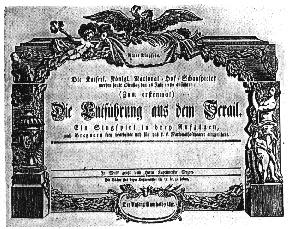
The opening night playbill of Die Entfürhung
at the Burgtheater, Vienna July 16, 1782
    The premiere of Die Entführung was at the Burgtheater in Vienna on July 16, 1782 and it was an unqualified success. There were rave reviews. For a short time, Mozart became the rock star operatic composer that Handel had been fifty years earlier. Emperor Joseph II had found his “UberSingspiel-Komponist” (“Over-the-top Composer of Singspiel”), if you will. Even though the Nationalsingspiel project was ultimately given up as a failure, Mozart's Die Entführung emerged as its exemplar. It was performed repeatedly in Vienna and German-speaking Europe. The Emperor, who actually was quite musical (unlike the all-thumbs musical duffer he was portrayed as in Milos Forman and Peter Schaeffer’s movie Amadeus), was astonished  by the sheer inventiveness and brilliance of Mozart’s effort. The story goes (as per Mozart’s first biographer Franz Xavier Niemetschek)   its Niemetschek in 1798) that the Emperor went up to Mozart after the premiere and remarked, “That is too fine for my ears. There are very many (too many) notes, Herr Mozart.”  To which Mozart replied, “There are just as many notes as should be.”
   The supreme German poet and author Johann Wolfgang von Goethe greatly admired Mozart, fifteen years his junior. When Goethe was director of the Theater at Weimar from 1790 to 1795, he had  Die Zauberflote  produced over a hundred times. Goethe, just as Mozart before him, was determined to make German Singspiel an art form on a par with Italian opera, and to that end wrote six Singspiele of his own between 1781 and 1784.  Along the way, Goethe heard Die Entfhürung and commented that "all our endeavors (in Singspiele)... to confine ourselves to what is simple and limited were lost when Mozart appeared. His Die Entfhürung has conquered all....

Aleksandra Kurzak as Blondchen
and Kristinn Sigmundsson as Osmin
Metropolitan Opera 2009
    What to listen for in Die Entführung ?  A kaleidoscope of sounds intertwoven with myriad musical treasures. For starters, there is the brilliant overture – lively, tuneful, replete with cymbals, triangles, piccolo and bass drum, (to conjure the impression of Turkish Janissary music), a musical rarity at that time.

Then there are the incredible virtuoso arias – especially those for Konstanze and Belmonte, the heroine and the hero – among the most beautiful and most difficult in the whole operatic literature. Mozart was blessed with remarkable sopranos during his compositonal life, In this case it was the sublime Catarina Cavalieri, whom he cast as Konstanze.  Cavalieri, who among other things was Antonio Salieri’s lover, apparently had a crystalline voice of almost three octaves, and Mozart duly wrote arias both to suit her tessitura and challenge her artistic skill. Mozart in fact had said that he had written some “bravura Italian arias,… for the flexible throat of Mlle. Cavalieri.”  Konstanze’s first aria, a ten minute symphonic tour de force which appears to have been airlifted from one of his opera seria efforts and plopped down smack dab in the middle of this lovely farce, is the showpiece Martern Aller Arten, which Beverly Sills famously nicknamed Aller Fall Aparten !  Fiendishly difficult even for the best coloraturas, it has challenged sopranos for over two centuries, which is a reason why Die Entführung is not performed very often. A famous soprano was once asked which aria was the most difficult to sing in all of opera. She immediately responded, “Why, Konstanze’s aria, Marten aller Arten of course .... (pause).... and that is only because  Konstanze’s  other  aria, Ach, ich liebte, is unsingable !”

    Belmonte has four world-class arias, heroic songs of such poignancy and longing that although they are for a tenore leggiero Fach (a light tenor musical range), one can see how they would eventually transfigure into the Heldentenor arias in Fidelio and the Wagnerian operas. There is also an eerily prefigured harkening in these Belmonte arias to those of Tamino nine years later in Die Zauberflöte. (The Magic Flute). In fact, there are many parallels and symmetries between these two Sinsgspiels – the couples Belmonte and Konstanze going through their own trial by fire, morphing into Tamino and Pamina; Blondchen and Pedrillo are transmuted into Papageno and Papagena, Osmin becomes Monostatos, Pasha Selim is kindred spirit to Sarastro. Only Die Königin der Nacht, the Queen of the Night, remains unpaired, as she should be.

     One of the most revelatory moments in Die Entführung occurs at the end of Act Two. At this point in the opera, four of the principals - Belmonte, Konstanze, Blonde and Pedrillo - find themselves alone. They each begin singing, as if to themselves, but then, magically, Mozart interweaves them as a quartet, an ensemble of blended voices that begin to have a conversation. This Act Two quartet is one of the first true ensemble pieces ever written in opera. Until then, virtually all operatic arias were solos or at most duets. It is a transformative moment in operatic history. In addition, both Belmonte and Pedrillo question the fidelity of their lovers, Konstanze and Blonde, foreshadowing the same eternal question that is at the epicenter of that later and sublime Mozartean opera of genders, Cosi fan Tutte.

      Then there is the matter of Osmin. Oh yes, Osmin, the emblematic bad guy (there is almost always a bad guy in opera). Die Entführung can only be staged if a company has a great Osmin (Kurt Moll comes immediately to mind). That is because Mozart, ever the pragmatist and opportunist, took advantage of the presence of a splendid bass in his midst, one Ludwig Fischer, who sang Osmin in the Vienna premiere with Madamoiselle Cavalieri. Among Osmin’s feats is his great aria “O wie will ich triumphieren” where in several places the bass has to sing down to a D2, that is, a D almost two octaves below middle C ! There is virtually nowhere else in the operatic literature that demands that low a note from its basso profondo.

    Many devotees of Die Entführung have long and wistfully wondered why Pasha Selim does not sing – his is a pure speaking role in the opera. In the parallel to Die Zauberflöte, Pasha Selim would be aligned with Sarastro. Sarastro has two magisterial arias.  So, why doesn’t Pasha Selim have at least one?  Would Mozart really turn over in his grave if, as John Yohalem posits in Opera Today, a Zaide aria was “borrowed” for Selim?  Doubtful. Or, maybe, one of Belmonte’s four somewhat repetitive arias was given  to the eternally songless Pasha? We shall never know.

      Die Entführung became a very successful opera in the decade Mozart lived in Vienna and in the years after he died. With time, the opera faded from view, and was only periodically revived. The key reason for this was the demanding nature of the arias,  but  the other issue was that the opera, and Singspiel in general, wasn't considered truly "Grand Opera," in the Wagnerian tradition that was to come. Later, much later, in the early twentieth century,  Die Entführung  was resuscitated and enjoyed a flowering in mid-century with many splendid and fine performances. It is a more commonly performed opera today than at any time since the years after its premiere.


The unfinished 1782 oil
of Mozart by his brother-in law
Joseph Lange

   With Die Entführung, Mozart again proved himself to be the consummate composer - innovative, pragmatic, clever and sophisticated - in short, the genius that he was in every musical genre. 
Die Entführung is a winner of an opera, with brilliantly conceived music and with melodies  which presage Mozart's own transcendant Die Zauberflöte, making it  too  a masterpiece.

Copyright 2012 Vincent de Luise MD A Musical Vision